We immensely enjoyed our brief stay in Rome; which is a problem. It’s a problem we’ve had to get used to, ever since we came to the UK and started travelling about: we’ve been to a lot of places, seen a lot of things, enjoyed everything immensely, and realised that we’ve only scratched the surface of what there is to see and do … We’ll have to come back!
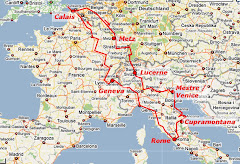
But today we had to turn our backs on Rome and head north. Rome to Calais is about 1,000 miles, or 1700 km, which is a bit much to do in one day or even two, so we’d planned to split it across three days. Just like on our way from Calais to Venice, we’d booked no accommodation for the return journey, and were leaving the exact details to chance (it worked on the way down, after all), but our vague plans were to stop overnight somewhere in the vicinity of Genova (north Italy) and Dijon (west central France) respectively. And to make it interesting, we elected to drive up Italy’s west coast, rather than take the “boring and expensive” Autostrade. The car had 1631.4
  miles on the clock, and we expected it to be around 3,000 when we got to Calais, after detouring for some sightseeing en route. (Limbering up our French for a little more use, you see …).
Sadly, we forgot to take a photo of the hotel before we left (though we think we’d recommend it); but we did get this photo from our window, of the houses across the street.
We stuck with tradition by getting slightly lost out on our way out of Rome (we missed the GRA again!), but Margaret’s map-reading skills meant we easily recovered. Before we left the hotel, Don had walked down to the Bancomat to get some cash, but found that all his HSBC cards had been blocked (Friday 13?). It was quite a long walk there and back, so rather than trying again with Margaret’s cards, we set off with not much cash and found our way to the SS1, paralleling the coast northward and affording glimpses of the Mediterranean.

After about four hours’ driving, we passed Pisa and saw the Leaning Tower not too far away to our left, though we didn’t actually drive round to it (or stop for a photo, which is a pity) because of concerns for time. The SS1 isn’t the fastest of roads by any means, especially as it not infrequently becomes the High Street of some small town or other … The need for progress accounts for the sad lack of photos for this part of our trip, so if you’re at all puzzled by today’s photos so far, you’ll learn about them further on …
We had to stop for petrol at one point, and were able to conserve our cash by using Don’s Amex at the area di servizio. Just north of Pisa and Viareggio, though, we were passing (relatively slowly) through a little town, Lido di Camaiore, when Don spotted a bank with ATM (and Cambio if we needed it) just down a side street. Margaret used her card to draw cash, and we used her cellphone to ring HSBC and get Don’s cards reinstated. (They were being overprotective; having seen several overseas transactions in the preceding two weeks, they’d rung us at home, got no reply, and decided to stop the cards “just in case”. We felt a phone-call to HSBC coming on when we get home …)
Now we had cash (and not having been able to see much of the Mediterranean in any case, since the SS1 isn’t realty a coastal road), we navigated a route to the A12 (A for autostrada, i.e., a motorway) in order to pick up speed. Our original target for the night, you may recall, was Genova; but when we reached there about 18:00, couldn’t think why we’d stop (a big industrial city, it seemed to us, of whose attractions we knew nothing—though our view was probably coloured by the port area we were driving through), so we had a hurried consultation and decided to press on to Geneva instead (being half-way to Calais rather than a third of the way).
Margaret re-plotted the route , and without stopping we drove above Genova (there’s a spectacular flyover, the Sopraelevata) and kept heading northwards, with occasional backdrops of the Mediterranean on our left, and mountains on our right—plus increasingly spectacular mountains straight ahead (the Maritime Alps, perhaps?).

In Switzerland, we’d had to drive with our headlamps on all the time. In Italy, you don’t have to do that (though many people do), but you must use your headlamps on the Autostrade. This is because (as we’d already found), in the mountainous parts of Italy, the Autostrade go through many tunnels. This, we felt, might partially explain why it was Italian rather than Swiss engineers (gli insabbiati) who had done the amazing tunnelling for the Tongariro hydro-electric scheme in New Zealand in the 1960s and 1970s.

At all events, the road featured many tunnels leading up to the Mt Blanc Tunnel, at 11.6 km only 2/3 the length of the St Gotthard, but still a respectable distance to drive in the knowledge that there’re millions of tons of rock just above your heads … and knowing also that you were in the tunnel where 41 people died in the spectacular fire of 1999!
We entered the tunnel at Courmayeur (in Italy, despite its French name; languages get very mixed up in border regions!), and exited at (or at least, almost at) Chamonix, in France, oblivious of the customs booths at the one end and finding them apparently unmanned at the other. The convenience of international travel in the EU!
But before we drove in, a stretch and a loo-break seemed a good idea, so here at last we took some photos—well, you had to really, despite its being well advanced into twilight: there was a clear sky, a gibbous moon, and mountains with glaciers and streams … All today’s photos so far were taken here.
At the far end, Don would have liked to take a side-trip through Chamonix, which he visited once as a teenager, but it was around 9 p.m. and we still had an hour of travel before reaching Geneva. There was no more ceremony entering Switzerland than there had been entering France (which of course we did a long way underground, strictly speaking): although we’d had to stop to buy our annual motorway permit when entering Switzerland from Germany, here the booths seemed to be completely empty and we drove straight through (feeling rather smug, though, knowing that we were legal anyway until New Year!).

The Chamonix valley features quite a large number of glaciers, but the biggest (Don remembered from his visit, almost 50 years before) is the Mer de Glace, the Sea of Ice. We’re not sure what the glacier was that we glimpsed from the road after we’d left the tunnel exit plaza; probably not the Mer (not a lot like Turner’s celebrated painting), but spectacular enough to make us find somewhere to pull off the road for a dimly-lit photo.
Arriving in Geneva, we found we had only maps that showed us how to get round it, not into it; so we followed signs that directed us to the city centre. We stopped at an intersection, and asked a couple of police officers (male and female) where we might find a hotel; they directed us “that way”.
Sure enough, we found a hotel in the central city that seemed to have parking outside, so—although it looked rather expensive—Don went in to enquire. Just as he got inside, there was a portent: a burst of fireworks and distant but loud cheering. What was going on?
The receptionist said yes, they had a room, but it was hideously expensive (not her exact words). Were there other hotels of a cheaper sort? Yes, she said, we’d find cheaper hotels down towards the railway station, helpfully marking the route onto a give-away map of the city. But (she said) we might have trouble getting a room: the city was full that night because of Les Euros. The European Cup! And it was (we think) the only night that there was actually a game in Geneva!
As we drove away, heading for the station area, we saw large groups of people milling about in the streets, mostly looking quite celebratory, and many of them wearing soccer supporters’ hats and scarves. We drove around a number of streets and found a number of hotels, but none of them with parking. Following someone’s suggestion, we headed out towards the airport and tried to get to an airport hotel, but although we saw several, we found ourselves completely baffled by one-way systems and couldn’t get close to any of them.

Around 11:15 at night, after having driven miles since we left that first hotel (and feeling increasingly worried we’d have to spend the night in the car), we took a different turn, and there it was: La Colombière: hotel and restaurant, open (with diners), with off-road parking, and here. (The photo is from the next morning.)
Yes, the waiter who spoke with Don assured us, they had une chambre; une chamber pour deux; une chambre très belle! And he named a figure. “Oh,” (seeing Don’s face), “c’est trop chere? Moment …”—and after a little work with a pencil, he asked if a figure with 25% off would be satisfactory.
Don consulted Margaret (waiting in the car), and, at 11:30 p.m. (by now) it was! The waiter (who reminded us of our dear Welsh friend Mike, back in Wellington) showed us up to the room, which was under the roof and was, indeed belle, then we went back down and asked if it was too late to get a meal, since we’d just driven from Rome (“De Rome!?!?”) without one. The staff rallied round and (agreeing that pizza, their main dish, probably wasn’t what we’d want after almost two weeks in Italy) brought us a beautiful antipasto and two glasses of wine.
While we were dining, a family turned up—father, mother, two late-teen daughters, and a son—and sat at the next table. It was obvious that the staff knew them well, and treated them as old friends. In fact (as it turned out), they were the owner and his family, minus another daughter who was sort of with them, but only because she was actually on duty that night. They sat, drank, chatted (in oddly-accented French), and laughed a lot, until suddenly the papa (aha!—they’re Italian, not Swiss) produced a piano accordion and began to play intricate, rapid folk-tunes. We were enchanted! But it as now after midnight, and we were tired from a day’s unremitting journeying; it was time for bed.
But today we had to turn our backs on Rome and head north.
 Rome to Calais is about 1,000 miles, or 1700 km, which is a bit much to do in one day or even two, so we’d planned to split it across three days. Just like on our way from Calais to Venice, we’d booked no accommodation for the return journey, and were leaving the exact details to chance (it worked on the way down, after all), but our vague plans were to stop overnight somewhere in the vicinity of Genova (north Italy) and Dijon (west central France) respectively. And to make it interesting, we elected to drive up Italy’s west coast, rather than take the “boring and expensive” Autostrade. The car had 1631.4
  miles on the clock, and we expected it to be around 3,000 when we got to Calais, after detouring for some sightseeing en route. (Limbering up our French for a little more use, you see …).
Sadly, we forgot to take a photo of the hotel before we left (though we think we’d recommend it); but we did get this photo from our window, of the houses across the street.
We stuck with tradition by getting slightly lost out on our way out of Rome (we missed the GRA again!), but Margaret’s map-reading skills meant we easily recovered. Before we left the hotel, Don had walked down to the Bancomat to get some cash, but found that all his HSBC cards had been blocked (Friday 13?). It was quite a long walk there and back, so rather than trying again with Margaret’s cards, we set off with not much cash and found our way to the SS1, paralleling the coast northward and affording glimpses of the Mediterranean.

After about four hours’ driving, we passed Pisa and saw the Leaning Tower not too far away to our left, though we didn’t actually drive round to it (or stop for a photo, which is a pity) because of concerns for time. The SS1 isn’t the fastest of roads by any means, especially as it not infrequently becomes the High Street of some small town or other … The need for progress accounts for the sad lack of photos for this part of our trip, so if you’re at all puzzled by today’s photos so far, you’ll learn about them further on …
We had to stop for petrol at one point, and were able to conserve our cash
 by using Don’s Amex at the area di servizio. Just north of Pisa and Viareggio, though, we were passing (relatively slowly) through a little town, Lido di Camaiore, when Don spotted a bank with ATM (and Cambio if we needed it) just down a side street. Margaret used her card to draw cash, and we used her cellphone to ring HSBC and get Don’s cards reinstated. (They were being overprotective; having seen several overseas transactions in the preceding two weeks, they’d rung us at home, got no reply, and decided to stop the cards “just in case”. We felt a phone-call to HSBC coming on when we get home …)
Now we had cash (and not having been able to see much of the Mediterranean in any case, since
 the SS1 isn’t realty a coastal road), we navigated a route to the A12 (A for autostrada, i.e., a motorway) in order to pick up speed. Our original target for the night, you may recall, was Genova; but when we reached there about 18:00, couldn’t think why we’d stop (a big industrial city, it seemed to us, of whose attractions we knew nothing—though our view was probably coloured by the port area we were driving through), so we had a hurried consultation and decided to press on to Geneva instead (being half-way to Calais rather than a third of the way).
Margaret re-plotted the route , and without stopping we drove above Genova (there’s a spectacular flyover, the Sopraelevata) and kept heading northwards, with occasional backdrops of the Mediterranean on our left, and mountains on our right—plus increasingly spectacular mountains straight ahead (the Maritime Alps, perhaps?).

In Switzerland, we’d had to drive with our headlamps on all the time. In Italy, you don’t have to do that (though many people do), but you must use your headlamps on the Autostrade. This is because (as we’d already found), in the mountainous parts of Italy, the Autostrade go through many tunnels. This, we felt, might partially explain why it was Italian rather than Swiss engineers (gli insabbiati) who had done the amazing tunnelling for the Tongariro hydro-electric scheme in New Zealand in the 1960s and 1970s.

At all events, the road featured many tunnels leading up to the Mt Blanc Tunnel, at 11.6 km only 2/3 the length of the St Gotthard, but still a respectable distance to drive in the knowledge that there’re millions of tons of rock just above your heads … and knowing also that you were in the tunnel where 41 people died in the spectacular fire of 1999!
We entered the tunnel at Courmayeur (in Italy, despite its French name; languages get very
 mixed up in border regions!), and exited at (or at least, almost at) Chamonix, in France, oblivious of the customs booths at the one end and finding them apparently unmanned at the other. The convenience of international travel in the EU!
But before we drove in, a stretch and a loo-break seemed a good idea, so here at last we took some photos—well, you had to really, despite its being well advanced into twilight: there was a clear sky, a gibbous moon, and mountains with glaciers and streams … All today’s photos so far were taken here.
At the far end, Don would have liked to take a side-trip through Chamonix, which he visited once as a teenager, but it was around 9 p.m. and we still had an hour of travel before reaching Geneva. There was no more ceremony entering Switzerland than there had been entering France (which of course we did a long way underground, strictly speaking): although we’d had to stop to buy our annual motorway permit when entering Switzerland from Germany, here the booths seemed to be completely empty and we drove straight through (feeling rather smug, though, knowing that we were legal anyway until New Year!).

The Chamonix valley features quite a large number of glaciers, but the biggest (Don remembered from his visit, almost 50 years before) is the Mer de Glace, the Sea of Ice. We’re not sure what the glacier was that we glimpsed from the road after we’d left the tunnel exit plaza; probably not the Mer (not a lot like Turner’s celebrated painting), but spectacular enough to make us find somewhere to pull off the road for a dimly-lit photo.
Arriving in Geneva, we found we had only maps that showed us how to get round it, not into it; so we followed signs that directed us to the city centre. We stopped at an intersection, and asked a couple of police officers (male and female) where we might find a hotel; they directed us “that way”.
Sure enough, we found a hotel in the central city that seemed to have parking outside, so—although it looked rather expensive—Don went in to enquire. Just as he got inside, there was a portent: a burst of fireworks and distant but loud cheering. What was going on?
The receptionist said yes, they had a room, but it was hideously expensive (not her exact words). Were there other hotels of a cheaper sort? Yes, she said, we’d find cheaper hotels down towards the railway station, helpfully marking the route onto a give-away map of the city. But (she said) we might have trouble getting a room: the city was full that night because of Les Euros. The European Cup! And it was (we think) the only night that there was actually a game in Geneva!
As we drove away, heading for the station area, we saw large groups of people milling about in the streets, mostly looking quite celebratory, and many of them wearing soccer supporters’ hats and scarves. We drove around a number of streets and found a number of hotels, but none of them with parking. Following someone’s suggestion, we headed out towards the airport and tried to get to an airport hotel, but although we saw several, we found ourselves completely baffled by one-way systems and couldn’t get close to any of them.

Around 11:15 at night, after having driven miles since we left that first hotel (and feeling increasingly worried we’d have to spend the night in the car), we took a different turn, and there it was: La Colombière: hotel and restaurant, open (with diners), with off-road parking, and here. (The photo is from the next morning.)
Yes, the waiter who spoke with Don assured us, they had une chambre; une chamber pour deux; une chambre très belle! And he named a figure. “Oh,” (seeing Don’s face), “c’est trop chere? Moment …”—and after a little work with a pencil, he asked if a figure with 25% off would be satisfactory.
Don consulted Margaret (waiting in the car), and, at 11:30 p.m. (by now) it was! The waiter
 (who reminded us of our dear Welsh friend Mike, back in Wellington) showed us up to the room, which was under the roof and was, indeed belle, then we went back down and asked if it was too late to get a meal, since we’d just driven from Rome (“De Rome!?!?”) without one. The staff rallied round and (agreeing that pizza, their main dish, probably wasn’t what we’d want after almost two weeks in Italy) brought us a beautiful antipasto and two glasses of wine.
While we were dining, a family turned up—father, mother, two late-teen daughters, and a son—and sat at the next table. It was obvious that the staff knew them well, and treated them as old friends. In fact (as it turned out), they were the owner and his family, minus another daughter who was sort of with them, but only because she was actually on duty that night. They sat, drank, chatted (in oddly-accented French), and laughed a lot, until suddenly the papa (aha!—they’re Italian, not Swiss) produced a piano accordion and began to play intricate, rapid folk-tunes. We were enchanted! But it as now after midnight, and we were tired from a day’s unremitting journeying; it was time for bed.

.jpg)
1 comment:
So wonderful to hear about your trip - I feel like I was there and have a craving for pizza :)
Hope to post some photos from our trip soon. It was wonderful catching up with Melissa and meeting Paul!
xo
Alice
Post a Comment