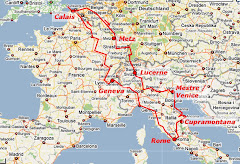
 and quite a lot of tunnels (don’t hold your breath through the Gotthard—at 16.4 km, it’s the third longest in the world). It took us into Italy at Como, where we suddenly began to encounter road signs we couldn’t read, not the way we’d been able to read and understand most French- and German-language signs. We also had to deal with toll roads for the first time, and our first experience was atypical in that we paid to enter the road. Mostly, as we soon found, you pick up a ticket to enter the road, then pay on exit. We soon got the hang of that, however.
Driving across northern Italy, through the plains of Lombardy, was actually quite unexciting. Motorways make driving on the right pretty easy, most of the time, and although we went passed some well-known cities—Milano, Bergamo, Brescia, Verona, Padova—the view was often of an uninspiring continuous industrial/commercial landscape, though we did get short patches of genuine Italian countryside: earth-coloured villas with those ridged tiles, olive plantations, cypresses and poplars on hillsides, and the Appennine chain to the south.
Eventually we came to “Venezia”, and left the motorway at Mestre, which is the coastal dormitory town for Venice itself. We had no real difficulties in finding the hotel, the Ambasciata, in the via Fagaré, just a few minutes’ walk from the railway station.
Our room was comfortable and so much better in appearance than the Lucerne hotel room. Leaving our suitcases there, we took the train into Venice itself. We suffered some slight trauma trying to buy tickets—Italian is so different from French, we couldn’t understand that the sign on the “Fast Tickets” machines was telling us that, for tickets to Santa Lucia Venezia, we must use the ticket office windows. But a helpful (impatient?) Italian lady eventually pointed it out to us, so we paid our 1 Euro each and went to the platform.
Venice is divided into a number of wards, of which the closest to the mainland is Ferrovia (“railway”!), where the Santa Lucia station is. You step out of the station into a piazza on the brink of the Grand Canal.
We crossed the bridge into the narrow little maze of twisty passages, all alike (or was it a twisty
 maze of little narrow passages, all alike?) that makes up the San Polo district, walking beside and over the little canali which, in many cases, represent the channels that formerly separated the eighteen islands that make up the main part of Venice. Thanks to a Month Python travel mockumentary of long ago, we were prepared for Venice to have “more f***ing gondolas” round every corner; but we weren't prepared for the many bridges, or—more precisely—their steps (up one side, down the other).
The city is full of decayed splendours from many different periods, though attempts are being made to clean some of them up (including plastering over the bare brickwork where old plaster has fallen away).

Eventually we got hungry enough for dinner, and found the Trattoria Da Silvio with a nice garden at the rear. Dinner was good (we’ve been eating well), but we got rather lost in the alleys as we tried to get back to Ferrovia, and in the end we had to consult the map (admission of failure?).

Eventually we got hungry enough for dinner, and found the Trattoria Da Silvio with a nice garden at the rear. Dinner was good (we’ve been eating well), but we got rather lost in the alleys as we tried to get back to Ferrovia, and in the end we had to consult the map (admission of failure?).
Back at the hotel, we tried the WiFi, for blogging purposes, but couldn’t get enough signal for a connection. So we went to bed instead.


No comments:
Post a Comment