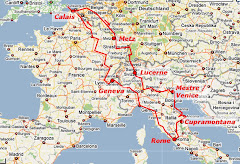
Monday, 30 June 2008

FRIDAY JUNE 6TH: DISCOVERING LE MARCHE

Il Vecchio Cantinone is a relaxing place, at least for the guests. We imagine it can be pretty busy at times for Ian and Jane, but we wanted to be as little burden to them as possible, so would be looking after ourselves as much as we could.

All the same, after several days’ driving and an intense time in Venice, we both felt a little ragged, and slept in for longer than we had so far. We breakfasted simply in Ian’s and Jane’s kitchen (coffee, toast, and cereal), then joined our hosts in lazing by the pool—and splashing around in it—until the storm that had been threatening finally rolled over from the surrounding hills in our direction, whereupon we went and lazed inside for a while instead.

While the weather was fine, we made the acquaintance of some of the local wildlife. A few days earlier, a fledgling wagtail had tipped itself out of its nest and taken up residence around the patio table and chairs, where its mother would fly down from time to time to feed it. We “discovered” it by one of us almost sitting on it as it rested on a chair. There were also the lizards, sunning themselves on the lavender-shadowed wall that went down beside the pizza oven. Don tried several times to photograph them, but they kept running away—though he succeeded in the end.

And then there were the cats. A lovely young tabby, not much more than a year old—little more than a kitten herself, small, slim and delicate-looking—had given birth to two kittens somewhere round the estate, and brought them down daily for food in the enclosed courtyard. Jane refused to name them, or allow them into the house, for fear of becoming attached …

Late in the afternoon, with the skies partially cleared again, Ian and Jane took us in their car for a bit of a tour, structured round a rather remarkable photographic exhibition, or rather, festival—Il Festival di Fotogiornalismo, allegedly the first of its kind in Italy (or possibly in Ancona Province). The organisers had decide to shun the cities, and spread the festival across six of the small towns of the province, starting (in alphabetical order) with Cupramontana: Jane’s and Ian’s local town, with a populace of around 4,500, sitting atop its own little flat-topped mountain (about 450 metres above sea level), and a little way down the road from their B&B. It was first settled around 600 BC, and named after a local fertility goddess …

First, though, Ian and Jane took us for a “tourist trip” in their car: up and down various hills, round hairpin bends on steep hillsides, and by or through little hilltop towns with names like Poggio Cupro, Maiolati Spontini, and Monte Roberto, in one of which we stopped for a look. It wasn’t quite our first experience of a Le Marche hilltop town (having visited San Leo), but it was really the first time we’d walked through the streets of one. But far more exciting were the views from, and of, the town walls. Those crazy mediaeval Italian builders again! (If only we could remember which town it was!)

Eventually we came to the first photo exhibition site, about 4 or 5 miles north-east of Il Vecchio Cantinone, at a lovely Napoleonic-era villa just outside the town of Pianello Vallesina, the Villa Salvati. The exhibition was Tomas van Houtryve’s “The Fall of a God-King” (recording the Maoist revolution in Nepal, and culminating in the 2008 elections). But although the photography was passionate and engrossing, our interest focussed rather on its setting, the somewhat decayed beauties of the Villa itself: plaster-moulded pillars and ceilings, ceiling paintings, frescoes, and sweeping staircases.

The second exhibition site we visited was Staffolo, where we saw a most disturbing black-and-while exhibition of street-crime photos (“See Naples and Die”) by Francesco Cito, before driving back to Cupramontana under more heavy, threatening clouds—a regular feature of Central Italian afternoons in June. This was our final stop in the photojournalism tour. The photos were displayed in the studios of Raul Bartoli, a Cupramontana native who died in 1994; they were by Sergio Ramazzotti (see other work of his here), and were themed on death: Islamic death rites, African animism, the Mexican “dia de los Muertos”, the Cairo necropolis, and so on.

After we came out from the exhibition, Margaret got a call from her office. They’d tried to get hold of her several times that day, but cellphone reception is chancy in Le Marche. The message was alarming: the company she works for, Pilat, were laying people off. Would she be affected directly, or indirectly via layoffs among her team? It cast a bit of a shadow over the evening, but there was nothing Margaret could do with her cellphone from Cupramontana at that time of day, so she arranged to ring her boss the following morning.

By now, dinnertime was not far off. Jane and Ian had arranged for us all to have dinner with English friends of theirs who ran a B&B not all that far away from their own. Before driving there, though, we paused in a trattoria for an aperitif of Campari, grapefruit-juice, and Prosecco (a cocktail apparently called “The Rainwater”, we learn from the Internet), served in champagne flutes. It was delicious.

The restaurant was called Crevalcuore del Lago, described on its sign as “ristorante tipico”. According to our dictionary, that means “a typical restaurant”, but we suspect we’re missing an idiom. (We were. Try "traditional restauranr".) It was under new management, and Ian’s and Jane’s friends (Tony and Leslie) were keen for it to succeed since it served good food, and was easy walking-distance from their place.

When we arrived, Jane providing an astonishing (to us) mastery of Italian, and got us shown to a table for eight. Waiting for the others, she and Ian ordered “The Rainwater”, but without knowing its name (particularly not in Italian), had to describe its ingredients instead. The pretty waitress, with amazing white spectacles, did her best, but with huge quantities of Campari and nowhere near enough Prosecco and no grapefruit juice at all, the result was a startlingly bitter concoction. At least, though, she left The Makings, so we were able to do better for ourselves later on.

Tony and Leslie soon arrived, bringing with them Clive and Anna, friends from England who were visiting them somewhat as we were visiting Jane and Ian. We ordered entrees and wine, and set in to get to know one another.

The dinner was going very well indeed at a social level; but several of us had ordered the grillo misto, mixed grill, for the main course; and right there it got a bit bad and sad. The entrees had been very promising, so the burnt state of the meats was extremely disappointing. Most of us who’d had grillo misto sent the main course back uneaten, and moved on to quite acceptable deserts. The restaurant was pretty nice about it (following Jane’s vigorous Italian) and rescinded the prices of the meals, but the damage was done. The Italian residents agreed to give them another chance sometime (because of the convenient location), but the signs—including the lack of other diners, apart from one table—weren’t good. Unable to enjoy the main course, we were forced to enjoy one anothers' company, which was no hardship at all!

We finished up with liqueurs (which brought Margaret to the discovery of limoncello), then made our way to Tony’s and Leslie’s place for more of the same. Jane took the women in the car, while the men walked the path past a patch of woodland, where fireflies flashed on off on short, mysterious paths through the vegetation.

Don had got into the wine somewhat, and (most uncharacteristically) can’t remember much more of the night. But Margaret says we had a very good time with our old and new friends, drinking whiskies (Don) and yet more Limoncello (Margaret). Don looks at the photos and believes her. At some time, presumably, Ian and Jane drove us back to Il Vecchio Cantinone and we went to bed …

Sunday, 22 June 2008

THURSDAY JUNE 5TH: SOUTH TO LE MARCHE

The chance hotel in Metz (the Cecil in rue Pasteur) was a good find; the Best Western in Lucerne coulda been better; the Ambasciata in Mestre (the only one we’d booked, so far) is one we’d recommend to friends. We left about 10 a.m., with 1178 miles on the clock since we rolled off the ship; time to head south again, to east central Italy.

Driving on the wrong side (i.e., the right side) hadn’t proved too much of a strain on the “A” roads (French Autoroutes / German Autostrassen / Italian Autostrade), which is to say the European motorways; but we’d decided to avoid them for most of the journey to our next main destination, near Cupramontana. This involved getting slightly lost on our way out of Mestre, but our error took us into, through, and round a couple of small Italian towns, which had its own interest; and Margaret recovered us so that, before very long, we were heading south along the SS309, running parallel to or alongside the Adriatic coast, through Chioggia [“Kee-Ojja”] and Comacchio [“Ko-Mahkio”], skirting Ravenna, and on towards Rimini.

(The West European “A” roads are the equivalent of UK motorways; the Italian “SS” roads—“SS” stands for Strada Statale, “State Highway”—are the equivalent of UK ”A” roads.)

It was a flat and sometimes marshy country landscape, with dense growths of bamboo in ditches along the roadside. The sea was a frequent companion; we passed or crossed occasional canals and rivers, and skirted small Italian towns, villages, and farm houses—some of the latter abandoned and decaying, with fallen roofs and tumbledown walls. We’d seen many such during our passage across the Lombardy plains, four days previously. Of course, constantly driving as we were, we have no photos of that part of our journey.

Just before Rimini, we turned left (west) onto the SP258 (“SP” = Strada Provinziale, again a UK-style “A” road) and headed for San Leo. Jane and Ian, the friends we’d be staying with “near Cupramontano”, had recommended it as “such an utterly perfect medieval village that it is considered by many to be Italy's most exemplary hill town”. It was our first experience of Le Marche (“Leh Markeh”, at least very roughly), which means “The Marches”: in modern English, “The Borderlands”, for historical reasons too complicated to go into here—follow the link!

It’s crazy country. Le Marche is a complex mass of mountains, hills, and valleys, and every second hilltop (and every third mountain) is capped by a tiny town a thousand years old defended by its remoteness and ten-foot-thick walls, sitting on the edge of vertical drops of hundreds of feet. Defended from whom? Well, from the town atop the hill the other side of the valley, for a start!

We drove up into San Leo, and then, confused by Italian roadsigns we still didn’t understand, parked at the bottom of the road leading up to the town fortress, and began walking up. (In fact, the sign we misinterpreted as meaning “no entry to this road” really meant “no parking on this road”, as we found out later.) It was a steep road with a hairpin bend halfway up, and it was just past the bend that the rain began. The clouds had looked threatening, so we’d put on rain jackets, and continued up the slope.

The castle is huge and fascinating. It’s built of stone and brick and, from the outside at least, looks like something put up in the 1950s, say, in terms of its wonderful preservation. In reality, it’s mostly of Renaissance construction, though parts of it are Roman! It was also the place in which the famous (infamous?) Count Cagliostro was imprisoned in the 18th century.

While we were there, the heavens truly opened: flaring lightening, rolling thunder, torrential rain, and punishing winds. We did quite a lot of sheltering under one arch or another before being able to make progress into the next courtyard, but during the lulls over San Leo, we had amazing views of the lightening marching across the neighbouring hilltops, and of the landscape lying beneath.

San Leo is in Italy, which was the seventh country of our trip (including England), but there was more to come, because our road back to the Adriatic coast took us downhill from San Leo and uphill into the independent republic of San Marino. Eight countries in eight days! It was darkling when we got there (a whole country that’s essentially a little town gathered round a hilltop fortress!), and so we didn’t have much time for sightseeing, but looked for dinner instead—and the fridge magnetti (of course, we got one from San Leo too).

From there it was back to Rimini, then down the coast to Ancona, a sharp left (west) turn again at Ancona, and inland to Ian and Jane’s place, just west of Cupramontana.

Jane was a contemporary of Margaret’s at school in New Zealand; Ian, like Don, is a Kiwi of English birth, though he went to NZ at a much younger age than Don. The two of them did IT contract work in the UK for many years. In 2000, the idea was born of setting up home in Le Marche, and at the end of 2005—after we and they had hooked up in London, but we’re sure that wasn’t the actual motivator!—they finally “retired” to run a B&B they had set up a little to the west of Cupramontana, under the name Il Vecchio Cantinone: “The Old Wine Cantina” (see the history here).

Our hosts made us welcome, showed us our aprtment (ground floor; lounge window just above the car's bonnet), gave us a partial tour, and sat us down for a natter and some drinks; specifically, glasses of the local white wine, Verdicchio ("Vair-dickie-oh").

It was with these congenial folks, and in their welcoming home, that we were to base the next several days of our holiday …

Saturday, 21 June 2008

WEDNESDAY JUNE 4TH: MURANO

Mid-week, the fifth day of our holiday, and our last in Venice. What should we do today?

Margaret knew. She had two ambitions for Venice. The first was satisfied on Tuesday evening, with the help of Fabio and his gondola Sebastiano (or possibly Ginevre). The other was to go to Murano.

Murano is a separate largish island in the Venice lagoon—or, to be precise, it’s a group of islands separated and joined by canali and bridges. (It has its own Canale Grande.) The thing about it is, it’s a good half-kilometre from Venice itself, and therefore a useful place to store valuable involuntary arsonists.

A fire in Venice must be hellish: bad enough at the side of a canal, where at least the fire brigade can have reasonably quick access, but unimaginable anywhere down those narrow twisty mazes of little passages, all alike. So an offshore island is an ideal place to banish all your glassmakers along with all their dangerous furnaces, which is what Venice did in the 13th century. There, they flourished and established the world-famous Murano Glass industry (though actually, Murano glass had begun to become famous four centuries earlier). Margaret’s ambition was not only to go there, but to buy some!

We hopped on the train and crossed the causeway to Venice (the orange strip coming in from the left in the map—click on it to see it full-size), and caught the No. 41 vaporetto heading west, because it goes the long way round, a sort of "sea cruise" via the Canale della Giudecca which separates “mainland” Venice from that long skinny east-west island to the south. The route goes round Venice’s “industrial” areas, as well as by the international port, where some HUMUNGOUS liners come in …

Murano (being an artisan district) has little of the grandeur of Venice itself (though we understand that the cathedral, which we didn’t see, is pretty good). And it turned out that, on a Wednesday afternoon (it’s quite a long trip from Ferrovia), it had little of anything else, either, at least, not when we were looking for lunch—early closing day, you see! We wandered around a few streets (the canal-side paths are wider than in Venice), but didn’t find many food places, and none that were open, until we stumbled across Trattoria al Frati on Murano's own Grand Canal.

Fortified by food and drink, we strolled round the streets again, this time with different purpose: the Hunt for Glass. There was no shortage of glass shops, but none jewellery that Margaret liked, until we found Gioielli R.T. (“Jewels Rossetto Tiziano”), where she bought a necklace and two pairs of earrings (one pair a close match to a necklace she already had—clever girl!), while Don bought a silver-nibbed glass pen.

A visit to Murano wouldn’t be complete without a visit to a glass factory, except that, on Wednesday afternoons, they all close. Well, almost all: turned out that the Formia factory was still open (just) and we spent a good half hour watching some skilled workers playing with fire—the Venetians’ nightmare!

Strolling back to the boat landing, we saw several examples of the amazing glass sculptures that dot the Murano townscape. The one illustrated is in one of Murano’s relatively substantial open spaces. We also spotted, quite by chance, the Church of St Peter the Martyr (Peter of Verano), and went in. It dates from the mid-1300s (fine frontage from the early 1500s), and hosts some good murals, several Tintorettos, and a fine Bernini, but the best reason to include it in your own tours is its “ligneous sacristy”, which is to say, the Wooden Vestry, whose four walls are lined with the most brilliant wooden panels and reliefs, carved for a local school in the 1560s and rescued from the school’s demolition by the parish priest in 1815.

Back on the vaporetto, we continued on route 41, past San Michele island, rather lovely with the pink walls, white pillars, arches, and cupolas, and green cypresses of the Cimitero, which does indeed mean “cemetery” (and makes up the whole island—see http://en.wikipedia.org/wiki/San_Michele ), round the northern shores of Venice, and down into the Canale di Cannaregio, which leads back into the Grand Canal. We got off at Giglie, the stop before Ferrovia, and walked towards the station along the Rio (street) Tera Lista di Spagna, admiring the shops and stalls selling antiques, carnival masks, ceramics, jewellery, artwork, toys—and hand-made, hand-painted, wooden sculptures of mediaeval-style clowns (buffi), one of which we stopped to buy.

We wound up in the Piazzale Roma, a small piazza next to Ferrovia, where we chose the Ristorante Roma for our last dinner in Venice, at a candlelit table next to the Grand Canal. Because of the location (and its romantic eventide views), the prices were higher than we’d got used to in Venice. In fact, the prices, the service, and the food, all generated protests in the few web reviews we’ve since read; but speaking for ourselves, we found the waiters very friendly, the food and wine good, and the service excellent. Perhaps our superior experience, as compared with the Internet reviewers, came from the obvious pleasure we showed in engaging with the waiters (showing genuine interest in Venice, and in the problems of fires in particular), and our willingness to try speaking Italian rather than English.

So our last day in Venice ended happily for us both, and it was with a little sadness that we got onto the train for Mestre for the last time—vowing, as always when we visit places and fall in love with them, that we have to go back …

Tuesday, 17 June 2008

TUESDAY JUNE 3rd: A GONDOLA IN VENICE

As we’ve already written, Venice is made up of eighteen islands of various sizes, separated or joined (depending on your perspective) by canali (natural “channels”, before they were tamed into being “canals”). The Canale Grande separates them into two uneven groups: a smaller one to the west and larger to the east—except that the Canal's sinuous path, from northwest to southeast, makes the islands look like one mittened hand (to the left) grasping the thumb of another (to the right), with the right hand also grasping the fingers of the left; or like two snakes biting each other’s heads.

The Santa Lucia railway station, where we arrived from Mestre, is on the larger island-group, but at its extreme western end (its mittened “fingertips”). Alongside the piazza lying between the station front and the canal are landing stages for vaporetti (Venetian water buses. As a vaporetto stop, the landing stage is called “Ferrovia”, which means “railway”.) We bought two 48-hour passes and boarded the number 1 route to San Marco (St Mark’s), which lies at the outer base of the thumb of the “right hand”.

Along the way we saw numerous wonderful (but dilapidated) palazzi, many fascinating glimpses into little side canals, and many little details of architecture or decoration—balconies and windows with profusions of red flowers, ornate archways, or little gardens on terraces. There’s also the Rialto Bridge (the covered one which many people mistake for the Bridge of Sighs).

Approaching St Mark’s along the canal, the first thing you see is the Campanile (bell tower) behind the canal-front buildings. (The canal by this stage is the Canale di San Marco, a much wider canal separating “Venice” from the Isola di San Giorgio Maggiore, St George's Island.) As you approach, you can see the open space of the Piazetta San Marco, with the famous pair of pillars bearing statues of St Theodore and St Mark’s Lion, and the decorated frontage of the Palazzo Ducale; but you come to the landing stage well before you get to the piazetta, and you have to walk past a torrent of souvenir stalls, some of them selling quite excellent artworks, and some selling the kind of tourist tat we’re actually interested in (magnetti, fridge magnets, because we have to travel light).


Bypassing the piazetta for the moment, we looked down the small canal that runs up the east side of the Palazzo and Basilica (the rio del Palazzo), and saw the real Bridge of Sighs. It's detaling is quite decorative, but its overall shape is reminiscent of the upper half of a skull, which is appropriate because it leads from the Doge’s court rooms to the prison (whence its name).


Besides the Bridge of Sighs, there are three immediate attractions at St Marks: the Doges’ palace, the cathedral, and the campanile. We chose the latter first, and (the day being sunny if somewhat hazy) had wonderful views from the top (several photos from up there!). The bells were of technical interest because of Don’s past involvement with bell-ringing, but we were glad that we’d got down from the tower and into the piazetta when they started ringing them! We took that as a sign for lunch, so went and explored a couple of side alleys and found the Pizzeria Marciana, where we had antipasto and delicious formaggi misti (mixed cheeses).

Afterwards, we went through to the adjoining (and larger) Piazza S. Marco, which forms a right-angle with the piazetta, photographed the red porphyry lions, and joined the queue to get into the Basilica. When we got to the front, we were told that our backpack had to be left at a nearby church (S. Basso?), so Margaret waited while Don rushed off to find it—which wasn’t easy, in fact, since it’s down a side alley and not signposted. But back at S. Marco, the “left-luggage” ticket got Don straight to the front of the queue.

There was far too much for us to describe here, and it was all hugely impressive. You can find out a lot via the Interweb thingy, so let’s just say that its glittering assemblage of treasures looted from other churches (particularly from Byzantium) is utterly beautiful and completely breathtaking. Oh, we’ll also report Mark Twain’s unkind but amusing comment: that its diverse mix of cupolas, domes, and spires makes it look like “a vast warty bug taking a meditative walk”.

After St. Mark’s, we went back to the stalls again and bought the fridge magnetti, and also a T-shirt for Don, then got two Coca light (yes, that bit’s in Italian) and sat a while in the Giardini Reali (Royal Gardens), a pretty and shady park. There we watched a man amusing his daughter by trying to feed pigeons, and getting covered in them.

Then we took the vaporetto back up the Grand Canal, to the stop before Ferrovia (Riva di Biasio, on the San Polo side of the canal), walked a little way, and found ourselves a gondola. Our gondolier was Fabio; unlike many that we saw, he wore The Hat (straw boater with ribbon), a privilege which apparently gondoliers have to earn. Also unlike other gondoliers we saw, he actually sang us romantic songs (Santa Lucia, O Sole Mio, Volare—that sort of thing). His gondola was named Sebastiano (he told us), or possibly Ginevre, since one name was painted onto one side of the boat, and the other on the other side. Either way, he was a mine of tourist info about Venice, and we immensely enjoyed the ride, and his company.

The ride lasted about three quarters of an hour. Afterwards, recognising where we were, we retraced our path from last night to Trattorio Da Silvio, where we had a light dinner before walking back—more directly then before—to Ferrovia and taking the train back to Mestre.

The weather had been "chancy" all day, shifting between sunny and hot and clouded and showery (we had to buy brollies at San Marco!). Now it was a cloudy night, but not raining; but as we walked from the station to the hotel, there was a brilliant summer lightning storm over the mountains to the west. We heard no thunder, but great bolts of lightning, about two seconds apart, shot horizontally between clouds made white and purple by the glare. A spectacular end to a wonderful day!

MONDAY JUNE 2ND: INTO ITALY

The road south from Lucerne goes through quite a lot of spectacularly steep scenery, and quite a lot of tunnels (don’t hold your breath through the Gotthard—at 16.4 km, it’s the third longest in the world). It took us into Italy at Como, where we suddenly began to encounter road signs we couldn’t read, not the way we’d been able to read and understand most French- and German-language signs. We also had to deal with toll roads for the first time, and our first experience was atypical in that we paid to enter the road. Mostly, as we soon found, you pick up a ticket to enter the road, then pay on exit. We soon got the hang of that, however.

Driving across northern Italy, through the plains of Lombardy, was actually quite unexciting. Motorways make driving on the right pretty easy, most of the time, and although we went passed some well-known cities—Milano, Bergamo, Brescia, Verona, Padova—the view was often of an uninspiring continuous industrial/commercial landscape, though we did get short patches of genuine Italian countryside: earth-coloured villas with those ridged tiles, olive plantations, cypresses and poplars on hillsides, and the Appennine chain to the south.

Eventually we came to “Venezia”, and left the motorway at Mestre, which is the coastal dormitory town for Venice itself. We had no real difficulties in finding the hotel, the Ambasciata, in the via Fagaré, just a few minutes’ walk from the railway station.

Our room was comfortable and so much better in appearance than the Lucerne hotel room. Leaving our suitcases there, we took the train into Venice itself. We suffered some slight trauma trying to buy tickets—Italian is so different from French, we couldn’t understand that the sign on the “Fast Tickets” machines was telling us that, for tickets to Santa Lucia Venezia, we must use the ticket office windows. But a helpful (impatient?) Italian lady eventually pointed it out to us, so we paid our 1 Euro each and went to the platform.

Venice is divided into a number of wards, of which the closest to the mainland is Ferrovia (“railway”!), where the Santa Lucia station is. You step out of the station into a piazza on the brink of the Grand Canal.

We crossed the bridge into the narrow little maze of twisty passages, all alike (or was it a twisty maze of little narrow passages, all alike?) that makes up the San Polo district, walking beside and over the little canali which, in many cases, represent the channels that formerly separated the eighteen islands that make up the main part of Venice. Thanks to a Month Python travel mockumentary of long ago, we were prepared for Venice to have “more f***ing gondolas” round every corner; but we weren't prepared for the many bridges, or—more precisely—their steps (up one side, down the other).


The city is full of decayed splendours from many different periods, though attempts are being made to clean some of them up (including plastering over the bare brickwork where old plaster has fallen away).

Eventually we got hungry enough for dinner, and found the Trattoria Da Silvio with a nice garden at the rear. Dinner was good (we’ve been eating well), but we got rather lost in the alleys as we tried to get back to Ferrovia, and in the end we had to consult the map (admission of failure?).

Back at the hotel, we tried the WiFi, for blogging purposes, but couldn’t get enough signal for a connection. So we went to bed instead.

Monday, 9 June 2008

INTERIM SUMMARY

As you can see from what we’ve published so far, we’ve a lot to tell you about, and it all takes time.

So we’ve decided to publish our SHORT NOTES of daily events to-date right here-and-now, so people can see that we are alive and have been doing things! We promise (rashly?) that we’ll flesh them out, and correct them, later!

FRIDAY JUNE 6TH
Rest day. Lazed by pool until storm threatened, lazed inside, went out about 4 to look at photojournalism exhibitions in Cupramontana, Scaffolo &???, had aperitif in ??? & M got phone call about redundancies at Pilat, then to restaurant with Tony, Leslie, Clive & Anne, very burnt mains but the rest was OK, then back to Tony & Leslie’s for more Limoncello

SATURDAY JUNE 7TH
Woke very late after the depradations of the night before, drove into Jesi & wandered a bit but everything was closed, then to supermarket & back to Cantinone for lovely BBQ

SUNDAY, JUNE 8TH
Blogged in the morning (as far as Metz), then drove out for tour found in The Marches (Touring Club of Italy Heritage Guide). Started with Frassassi Caves (heavy rain waiting for bus -- lunch (porscietta?? in panini) -- caves astounding. Drove on (up) to Genga (through gorge), then Sassaferrato, then down to Fabriano -- didn't find the Abbey Di Val di Castro (tomorrow?) -- home for home-made pizzas also with Tony and Leslie.

MONDAY June 9th
Found the Abbey via Apiro, Domo, Precicchie, San Giovanni, Vigne; awesome hill country and villages; then to Fabriano -> Sassaferrato -> Pergola -> Urbino. Looked round Urbino, late lunch in nice piazza. East to Pesaro on coast, followed coast road south to Ancona, stopping for ice creams at Marotta, then back to Cantinone for dinner and blog.

SUNDAY, JUNE 1: FRANCE, GERMANY, SWITZERLAND

Over breakfast the next morning, we read in the local paper that the storm had been widespread and devastating, with lots of damage in the Lorraine region (around Metz and Nancy), as well as in the Ardennes where it had hit us. In particular, roads around Nancy were said to have been badly affected. This worried us because we’d decided to avoid the French toll roads (due east) and head into Germany via Nancy to the south. But we stuck to this plan, and although the road surface was disrupted in places, there was nothing bad enough to cause us problems. Two-and-a-half hours later, with no fuss whatsoever, we crossed the Europa Bruecke over the Rhine, and passed from the Avenue du Pont de l’Europe onto the Strassburger Strasse, and from France into Germany.

For quite a while before we’d crossed the border, the small towns we passed through had had German names (Steinbourg, Rosenwiller, Gotteshelm, Scherlenhelm …) and, increasingly, a south-German look; we thought of cuckoo clocks and Black Forest cherry cake. Our last French town was Strasbourg (German name, French spelling); our first German town was Kehl.

From there we headed south, between the Rhine on our right and the Naturpark Suedschwarzwald (southern Black Forest itself) on our left: a further hour and a quarter, with distant mountains gradually becoming clearer and less distant to the south as we approached the Swiss border. At that point we had to stop and buy a vignette (windscreen sticker) which showed that we had paid our annual motorway tax, entitling us to drive on Swiss motorways for a year (or at least, until December 31, when they all run out!).

We also turned on our headlamps. These are compulsory at all times in Switzerland, presumably because (as we later discovered) as you round any bend you’re likely to enter a tunnel a couple of miles long that takes you through some mountain or other. UK (and Australasian) headlamps are angled to the left to avoid dazzling oncoming drivers on your right, but of course in Europe left and right are reversed, and left-pointing headlamps is exactly what you don’t want. To cope with this, UK drivers are required to fit “headlamp converters” that mask the “bright spot” that does the dazzling. We’d fitted ours (a couple of stick-on discs) during our first stop in Belgium.

Switzerland was as much fun as we expected it to be, if you think of stunning scenery and crazy builders as “fun”. When more of your geography is vertical than horizontal, you have to be very inventive about where you build a house and how you get up to it!

It’s about three quarters of an hour from Basel to Sursee, where the river Sure (roughly, “Zooruh”) enters Lake Sempach -- in German, the Sempachersee. The E35 motorway follows the east side of the lake, and from time to time we got tantalising glimpses of beautiful scenery -- the lake itself, and the hills on the far side. Eventually, somewhere around Eich, we stopped at a picnic spot and managed to get some snaps through gaps in the trees.

At the south end of the lake is Sempach itself, and we decided to leave the motorway there and try to get down to the lake. We failed in that -- couldn't find a road that actually led to the shore, or anywhere to stop on the road we were on, appropriately called Seestrasse (“Lake Street”). It was taking us back north, parallel to the E35, but we were in plenty of time for Lucerne (our destination for the day) and decided to keep going. It was rather like driving the Glenorchy Queenstown Rd down the side of Lake Wakatipu, but don’t take the analogy too far: there aren’t many cows with cowbells round their necks grazing on the hillside pastures above Lake Wakatip!

Along the way we saw many examples of the astonishing “Swiss barns” -- in reality, combined barns and houses, with the ground floor for animals and upper floor for people. We would have liked to photograph at least one, but opportunities to pull off the road were very limited. Perhaps on the way back …

After about four miles, as we neared the north end of the lake, we passed under the motorway and decided to head off up the hillside. How could we get lost? We knew exactly where we were: Switzerland!

We saw a road sign pointing up to a place called Vogelsang, which means “Birdsong”. Irresistible! And an inspired choice. We drove up high above the lake and (cheekily) pulled into someone’s roadside parking space, adjoining a pretty house with a stunning view. We could easily see Sursee, not far to the northwest, and across the blue lake water could make out Oberkirch, Nottwill, and smaller communities climbing the mountainsides. And almost due south, massive snowy peaks showed above a distant, hazy horizon.

Seventeen photos later (including a panorama over the lake), we got back into the car and continued along the Vogelsangstrasse through the village itself (a modern place, from the look of it, though there were some very old-style barns), through Kirchbuehl, and back down to Sempach. As we drove through the town, we were tempted by the site of a traditional Swiss-style inn on the town square, but decided to press on to Lucerne. If we didn’t like it, or couldn’t find anywhere to stay, we could always come back.

Not like Lucerne? Only someone who’d never been there could have had such a thought. Commanding the exit of the River Reuss where it flows from the Vierwaldstattersee (which we sensibly call “Lake Lucerne”), surrounded by Alpine peaks to north, west, and south, and retaining so much of its mediaeval structure, it’s “Switzerland’s ultimate tourist destination”. We avoided the motorway, and came into the city from the north. As we crossed the river, we couldn’t help but see the amazing wooden Chapel Bridge (described below), not to mention the mediaeval churches and inns either side of the river.

On the south side of the Reuss, we circled a couple of times, looking for a hotel. Lucerne traffic is much busier than Metz’s, and Don was getting tired from driving, so in the end we picked the next one we saw with parking -- a Best Western, somewhat pricier than our usual, but a roof and a bed. It was billed as having four stars, and for sure the breakfast was good enough, but (as we’ve already written) we think we got better value with two stars in Metz.

We went for a walk through the immediate vicinity. The Chapel Bridge was just across from the end of the (short) road the hotel was in, so it was an inevitable first choice. Wooden with a slate roof, and dating from 1333 (originally), it takes a sort of Z-shape across the river, with a stone Wasserturm (Water Tower) about a third of the way across, which was originally the lucerna, or lighthouse, that the town is named after. (See http://travelguide.all-about-switzerland.info/lucerne-chapelbridge-watertower.html .) It was also a prison, a torture-chamber, and a treasury, but now it houses the souvenir shop where we bought our inevitable fridge magnet.


A striking feature as you cross is a series of captioned triangular paintings from the early 1500s, set into the roof-beams. Originally they chronicled the city's history, but the bridge was nearly destroyed by a fire in 1993, and much of what stands today is a restoration, with many empty spaces but with some original pictures that had been stored when the bridge was shortened about 100 years ago.


The other side of the river is very much “Old Town”, much of it impassable for cars. Walking through the narrow cobbled streets, we saw example after example of buildings decorated with mediaeval style carvings and paintings. A total feast for the eyes!

We crossed the river twice more, and made our way to a restaurant near the north end of the Chapel Bridge (Hotel des Alpes), where we sat by the side of the river and fed passing swans odd scraps of bread from our most delicious cheese fondue with wild mushrooms, followed by Schwarzwaldertorte (Black Forest cherry chocolate cake) for Margaret and a local cheese platter for Don. Then back across the Chapel Bridge to the hotel, and so to bed.

Sunday, 8 June 2008

IF TODAY'S MONDAY, THIS MUST BE VENICE!

(Click on the pictures to see them full-sized!)


Three days of travel through six countries, and we were there!

But what happened before? And what happened next? And what became of our blog?

As to the blog -- we’ve had an unbelievably marvellous time of enjoying ourselves here in “for’n parts”, and got back to our hotels at the end of each day quite worn out. We also had some problems with WiFi availability, but it was mostly end-of-day exhaustion, which we’re going to try to make up for now our holiday’s more than half-way through (today being Sunday, June 8).

So come with us, back through the mists of time …

FRIDAY, MAY 30: LEAVING HOME
We started, not in Venice (as in the old song), but in Acton (west London) -- almost an hour later than we'd anticipated because Don's train from Manchester had been cancelled, and he'd had to get a later one. But we completed our packing, loaded it all into the car, and set off for our first night's stopover, in Dover.

Of course, it still wasn’t quite as easy as that. The warning signs came (literally) as we drove round the M25. They were large, hanging over the motorway, and illuminated, and read: “A20 closed after A260”. Of course, the M20 (next after the M25) turns into the A20 somewhere between Folkestone and Dover, and (it turned out) after the A260 joins it. As a result we and 2,781 BIG trucks (we may have miscounted …) were diverted round and through the back streets of Dover at a snail’s pace and nowhere near the route we’d plotted to the hotel, or that the hotel had also sent us. Thanks to our el-cheapo but effective SatNav system, though (Margaret with a road atlas), we arrived there near midnight, only a couple of hours later than we planned …

Over the next three days we would travel almost 1,000 miles through six countries. But first, to bed.

SATURDAY MAY 31: FRANCE, BELGIUM, LUXEMBOURG
We had no definite plans either of routes or stopping places, but had plotted out a route to Venice that required about 14 hours’ driving time over three days, if we didn’t deviate from it. Well, we did (as we’d expected), though not too much.

Our ferry was the Pride of Calais. We’d booked priority roll-off and use of the Club Lounge for a little extra, although we arrived too late for the roll-off (you have to be at the head of the queue for boarding, but nobody mentioned that to us when we booked -- by phone -- and we were still naïve travellers at that stage). But the opportunity to relax in the lounge over a “free” glass of bubbly was irresistible, and we enjoyed it immensely.

Even without the priority booking, the roll-off was quite quick. Co-pilot Margaret seized the Google maps printout and, leaving Calais, we turned left (east, for those geographically challenged) and 30 minutes later crossed into Belgium, heading for Brugge (Bruges). The flat and fertile Flanders fields (yes, there were poppies) were picturesque, and many familiar names flowed past, usually in slightly unfamiliar guise: Dunkerque, Oostende, Brugge, Gent, Brussel, Waterloo, Ramillies … But we had many miles to travel, and made only brief stops for petrol and refreshment, and two diversions to see what a Belgian village might look like. (At our second stop, near Wavre -- a little south of Brussels -- we watched two men building a miniature garden in a corner of the service station near where we sitting. Having built it and filmed it in close up, the picked it up in the piece of cloth they’d built it on and went away. We’ll probably never know what it was about, but they also filmed the poster for some sort of bikies’ pets’ day that they’d built it under.)

Travelling southward through Namur, a beautiful Walloon (French-speaking) southern province of Belgium, we turned onto a side road to investigate a tower we’d glimpsed from the motorway (and to get another break from motorway driving). We went up through a pretty little village called Lavaux Ste Anne and found its Chateau, a 15th-century castle which “is made up of three corner towers and a cavernous keep; it represents the only example of an Ardenne Castle in an open countryside. It hosts today an amazing hunting museum,” which we didn’t know about until we looked it up on the Interweb Thingy and, sadly, wouldn’t have had time for anyway. But we took our own photos, and see also here.

Back on the motorway, we encountered a fierce and prolonged storm. For about half an hour we drove at reduced speed with torrential rain doing a good job of mimicking fog. But we emerged from that into sunlight and, after about five hours on and off the road, drove into Luxembourg and, not much later, out of it once more, to re-enter France.

We’d earmarked Metz as a likely stopping point, and, since it was 17:00-ish, we drove into the town, and circled around a bit looking for a hotel that (a) had parking and (b) didn’t look fabulously expensive. We found the Hotel Cecil in the rue Pasteur, allegedly two-star but (in our opinion) very much better than the four-star hotel we stayed in the next night. It was nice to be back in France, where we had some command of the language (not that you’d need it much because many people, especially anyone who’s likely to sell you something, speaks good English).

Having settled into our room, we went for a stroll around central Metz. Despite a hotel brochure claim that it was “steps away”, the Cathedral was too far to walk comfortably, but we had a pleasant evening stroll before we returned to the rue Pasteur and had dinner at Le Bistrot des Sommeliers, a “bar a vins” right next to the hotel. The waiter introduced Don to a very good white to drink while eating cheese (“Cotes de Jura”), and Margaret to a fabulous sweet red (she not being a red drinker) to go with a chocolate dessert (“Maury”).

We got to bed about 22:00, tired but ecstatically happy that our first week away (which is what it felt like after only one day) had been so fantastic.

But it's now 12:45, and (being in central Italy) we're off to do some more exploring. Catch you all later with the next episode!

-- D & M