 t Western in Lucerne coulda been better; the Ambasciata in Mestre (the only one we’d booked, so far) is one we’d recommend to friends. We left about 10 a.m., with 1178 miles on the clock since we rolled off the ship; time to head south again, to east central Italy.
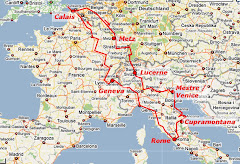
Driving on the wrong side (i.e., the right side) hadn’t proved too much of a strain on the “A” roads (French Autoroutes / German Autostrassen / Italian Autostrade), which is to say the European motorways; but we’d decided to avoid them for most of the journey to our next main destination, near Cupramontana. This involved getting slightly lost on our way out of Mestre, but our error took us into, through, and round a couple of small Italian towns, which had its own interest; and Margaret recovered us so that, before very long, we were heading south along the SS309, running parallel to or alongside the Adriatic coast, through Chioggia [“Kee-Ojja”] and Comacchio [“Ko-Mahkio”], skirting Ravenna, and on towards Rimini.
(The West European “A” roads are the equivalent of UK motorways; the Italian “SS” roads—“SS” stands for Strada Statale, “State Highway”—are the equivalent of UK ”A” roads.)
It was a flat and sometimes marshy country landscape, with dense growths of bamboo in ditches along the roadside. The sea was a frequent companion; we passed or crossed occasional canals and rivers, and skirted small Italian towns, villages, and farm houses—some of the latter abandoned and decaying, with fallen roofs and tumbledown walls. We’d seen many such during our passage across the Lombardy plains, four days previously. Of course, constantly driving as we were, we have no photos of that part of our journey.
Just before Rimini, we turned left (west) onto the SP258 (“SP” = Strada Provinziale, again a UK-style “A” road) and headed for San Leo. Jane and Ian, the friends we’d be staying with “near Cupramontano”, had recommended it as “such an utterly perfect medieval village that it is considered by many to be Italy's most exemplary hill town”. It was our first experience of Le Marche (“Leh Markeh”, at least very roughly), which means “The Marches”: in modern English, “The Borderlands”, for historical reasons too complicated to go into here—follow the link!

It’s crazy country. Le Marche is a complex mass of mountains, hills, and valleys, and every second hilltop (and every third mountain) is capped by a tiny town a thousand years old defended by its remoteness and ten-foot-thick walls, sitting on the edge of vertical drops of hundreds of feet. Defended from whom? Well, from the town atop the hill the other side of the valley, for a start!
We drove up into San Leo, and then, confused by Italian roadsigns we still didn’t understand, parked at the bottom of the road leading up to the town fortress, and began walking up. (In fact, the sign we misinterpreted as meaning “no entry to this road” really meant “no parking on this road”, as we found out later.) It was a steep road with a hairpin bend halfway up, and it was just past the bend that the rain began. The clouds had looked threatening, so we’d put on rain jacke
 ts, and continued up the slope.
The castle is huge and fascinating. It’s built of stone and brick and, from the outside at least, looks like something put up in the 1950s, say, in terms of its wonderful preservation. In reality, it’s mostly of Renaissance construction, though parts of it are Roman! It was also the place in which the famous (infamous?) Count Cagliostro was imprisoned in the 18th century.
While we were there, the heavens truly opened: flaring lightening, rolling thu
 nder, torrential rain, and punishing winds. We did quite a lot of sheltering under one arch or another before being able to make progress into the next courtyard, but during the lulls over San Leo, we had amazing views of the lightening marching across the neighbouring hilltops, and of the landscape lying beneath.
San Leo is in Italy, which was the seventh country of our trip (including Englan
 d), but there was more to come, because our road back to the Adriatic coast took us downhill from San Leo and uphill into the independent republic of San Marino. Eight countries in eight days! It was darkling when we got there (a whole country that’s essentially a little town gathered round a hilltop fortress!), and so we didn’t have much time for sightseeing, but looked for dinner instead—and the fridge magnetti (of course, we got one from San Leo too).
From there it was back to Rimini, then down the coast to Ancona, a sharp left (west) turn again at Ancona, and inland to Ian and Jane’s place, just west of Cupramontana.
Jane was a contemporary of Margaret’s at school in New Zealand; Ian, like Don, is
 a Kiwi of English birth, though he went to NZ at a much younger age than Don. The two of them did IT contract work in the UK for many years. In 2000, the idea was born of setting up home in Le Marche, and at the end of 2005—after we and they had hooked up in London, but we’re sure that wasn’t the actual motivator!—they finally “retired” to run a B&B they had set up a little to the west of Cupramontana, under the name Il Vecchio Cantinone: “The Old Wine Cantina” (see the history here).
Our hosts made us welcome, showed us our aprtment (ground floor; lounge window just above the car's bonnet), gave us a partial tour, and sat us down for a natter and some drinks; specifically, glasses of the local white wine, Verdicchio ("Vair-dickie-oh").
It was with these congenial folks, and in their welcoming home, that we were to base the next several days of our holiday …

No comments:
Post a Comment