 Italian Marches country, its hollow lands and hilly lands, its olive groves and cedar rows and farmsteads and poppy-purpled meadows and crazy, beautiful, mountain-top villages and cities within their massive ancient walls. And we’ve seen nowhere near as much of Ian and Jane as we’d like—and suddenly, it’s time to leave them, and their lovely surroundings, and head west through north central Italy.
  We make a swift tour of Il Vecchio Cantinone, The Old Wine-Cellar, making up for our lack of photos of the place: our downstairs apartment, the lounge, the patio breakfast area, the pool ... We snap the wee mother cat with the braver of her two delightful kittens (the one that looks nothing like her), cautiously peering in at the lounge door (how long, we wonder, before Jane’s resolve breaks and they become house cats?). We pose for mutual photos. We pack the car. And then it’s time to go.
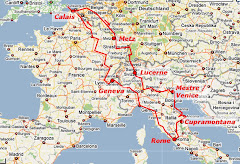
One thousand, four hundred, and fifty miles on
 the clock since we rolled off the ferry at Calais, eleven days ago; and about the same to go before we roll back on, in six days’ time. But today’s not a day for messing about; we’ve got two clear targets: Assissi, and then Rome. We hug and wave goodbye, and then we’re off up the via Esinante, onto the SS76, and speeding south-westwards, through Fabriano and Fossato di Vicolo, and into Umbria.
It’s motorway for two thirds of the way to Assisi, then at Gualdo Tadino we turned off onto a cross-country road and began to climb.
Assisi is another of those amazing walled cities strung out along the top of a ridge. Our first clear view was from a scenic pull-off area (about the only one we’ve seen in this highly s
 cenic country) where there was also an abandoned farm-wagon. Below us, a deep valley stretched to east and west, its sides rocky, its flanks green. At its west end, a ridge extended northwards from the southern valley wall where we stood. Atop it was a walled city of pale stone: castellated buildings, square towers, gleaming in the sun; a city from mediaeval romance.
 As usual, we hadn’t done our homework; we honestly enjoy being taken by surprise by the places we visit. We entered the town at what turned out to be the top end, but hey, where do you put the church? On top of the hill, right? Wrong …
We drove in through the Porta Perlici, found a parcheggio (our Italian vocabulary was now  becoming consolidated) in the piazza Giacomo Matteotti, and made for the nearest street leading down (literally) into the city. The day was bright and sunny, but the shaded air was cool in the narrow lanes between the stone-built houses.
A little way down, Margaret spotted an embroidery shop which also sold postcards and guidebooks. We went in and were charmed by some (to us)  unusual styles of embroidery. The very pleasant lady in the shop had little English, and we much less Italian, but between us we learned that both styles were local, and the one was called
Here there was a libraria (bookshop), the EREDI di E. ZVBBOLI, its name
 inscribed on beautiful tiles above the doorway (with more tiled inscriptions either side of the door), along with the slogan, Touring Club Italiano. This perked up Don’s interest, because he was keen to get a copy of the book, The Marche, which had helped us find our way around Jesi, Urbino, and the Frassassi Circuit. And, of course, Margaret was hoping for one or two local embroidery books.
Sadly, Don was disappointed (many other Touring Club books, but not The Marche). But Margaret was in luck, and bought a book with several traditional patterns in punto Assisi. She has a considerable collection of cross-stitch patterns, and completed cross-stitches, recording places we’ve been in England (and also several from Paris), but hadn’t really been surprised not to find any in Italy. Now, though, she’s all fired with enthusiasm to create an Assisi-work picture of Assisi for the collection. And it wasn’t a total loss for Don, either: he collects leather bookmarks of places we’ve been, but they too seem to be an essentially British thing, so we were both thrilled not only to find a leather bookmark of Assisi (we bought one), but to find also that a local artist made beautiful hand-painted bookmarks featuring Saint Francis and city scenes. We were so elated, and they were so lovely, that we bought two!
 We retired with our prizes to an umbrella-shaded table outside the Caffe Minerva, where we looked through the books and chatted over lunch. The café is named after the Tiempo di Minerva (“Temple of Minerva”, goddess of wisdom), which faces it across the piazza: a survival from
  pagan Roman times, long ago converted to Christian use as the church of Santa Maria Sopre Minerva. We mounted the steps that lead up to the classical façade (AD 30-something), went inside, and absorbed the hushed calm and admired the beautiful artwork. Not even the electrically-haloed Madonna forming the altar-piece seemed out-of-place.
But the main target for a first visit
 to Assisi has to be San Francesco, St Francis, and the magnificent basilica that houses his remains. Our walk had taken us downhill and westward, about half the distance to the Basilica. We continued along the via S. Francesco, catching occasional glimpses down narrow side-streets (“the small quiet side streets are amongst the best that Italy has to offer”) of beautiful small houses, stairways, arches, and the countryside that surrounds the city, until the Basilica came into sight .
By and large, the external appearance of Italian churches and cathedrals lacks the architectural beauty of northern European cathedrals, being built in Romanesque rather than “Gothic” style: massive walls, round arches, square towers, occasional domes, and relatively simple ornamentation, rather than pointed arches, columns and pinnacles, flying buttresses, an emphasis on verticality, and elaborate embellishment. The interiors (like that of Santa Maria Sopre Minerva) make up for this; but in S. Francesco, as in
 the Grotte di Frasassi, photography is forbidden, and we respected that condition, so we have only external photos to show. The artworks are as numerous and beautiful as one might expect, but the highlight is to visit the crypt which holds the tomb of St Francis, deliberately hidden to protect it soon after his death, but rediscovered in 1818.
Outside again, in the piazza alongside the lower basilica (down the ramp in the photo above), and with a small collection of magneti, we faced the prospect of a lengthy uphill walk back to the car … and turned our backs on it. There were a couple of taxis in the square, so we hired one, and experienced the rather pretty road up the outside of the town, the Viale Vittorio Emanuele II, which gives lovely views of the agricultural plain to the south, across to the basilica of Santa Maria degli Angeli.
Back in the car, we left the car park and (in Italian, and feeling very proud of our abilities)
 consulted a passing gentleman for the best way out of the town towards Rome. The drive itself was uneventful and was much more “journey” than “sightseeing”, though we avoided the boring and expensive Autostrade and took secondary roads through Peruggia, Terni, and Narni (where we had to stop at one point—near Testaccio, just south of Narni—for a photo of a romantic rocca perched high among woodland).
We approached Rome from the north, along the via Flaminia (an ancient pilgrim route, we later learned). From there we had maps and directions that should take us clockwise round the A90 orbital roadway so we could approach our hotel (the Villa Rosa in the Trastevere) from the south by a reasonably major road without having to cross the inner city and brave its traffic, a prospect which terrified us. As we discovered, we needn’t have worried too much on that score. We mislaid the A90—as we later found out, it’s actually signposted as “GRA”, not “A90”—and found ourselves heading ever deeper into a maze of streets and a world of lostness … Traffic was thick, but, we were pleased to find, orderly, and since by now Don had quite a lot of experience driving on the right, the driving itself wasn’t too much of a strain—not for someone who’s braved inner London traffic for a few years now!
What was more of a strain was the growing, pressing, need for a loo … Eventually we found somewhere we could stop outside a ristorante, used its facilities, and were able to settle down to finding out where we were (we had a map) and where we needed to go. Before long, Margaret found a street that we could also find on the map, and worked out a route to the hotel, which turned out to be only slightly confounded by the usual vicious one-way system that old cities usually have.
We finally got to the hotel, in a quiet side street above a major road (the Circonvallazione Gianicolense), about 9 o’clock at night. The friendly and helpful male receptionist, who spoke excellent English (they all do) and didn’t laugh at our tired attempts at Italian (they never have), gave us good advice about getting into the city the next day by public transport. But (he told us) the hotel had no WiFi, despite the web site we booked through having said that it had. That was a bit of a blow (once more, no blogging), but we realised that, if the past week or so was anything to go by, we’d be getting back to the hotel quite late and not feel like blogging anyway.
Although it was late, we were hungry; so we left the hotel and walked down a series of steps to the Circonvallazione, where we had dinner across the road at the Trattoria e Ristorante Da Claudio, a traditional-style ("tipico"?) Italian family restaurant, where again the staff were friendly and spoke good English. And then we went back to the hotel, and to bed.


No comments:
Post a Comment